Grilling Basics
Why Resting Meat Matters and How Long to Rest It
Resting meat after grilling lets juices redistribute and carryover cooking finish. Learn how long to rest steak, brisket, and more.
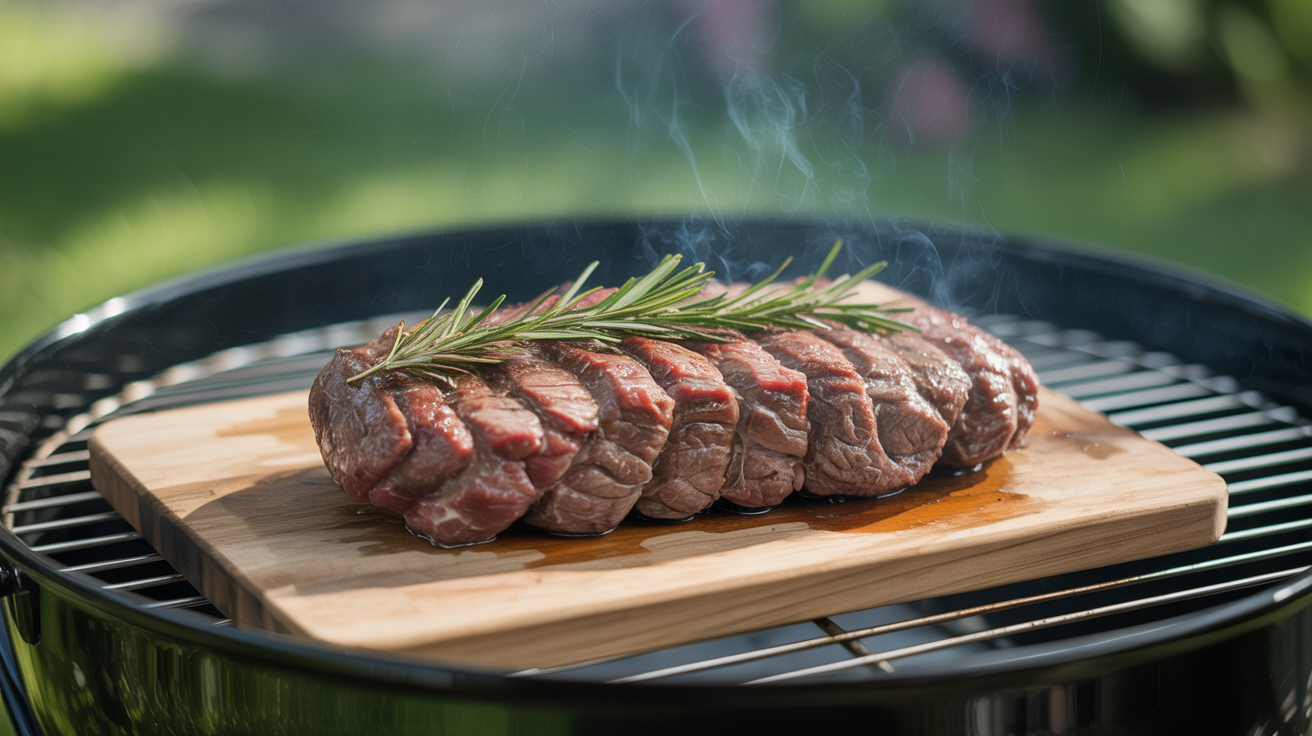
Resting meat after grilling is one of the simplest things you can do to get better results, and one of the most skipped. Cut into a steak too early and you will watch a pool of juice run onto the board, leaving the meat drier than it needs to be. Give it a few minutes off the heat and most of that stays inside where it belongs.
What Actually Happens When You Rest Meat
Two things are going on during a rest: juice redistribution and carryover cooking.
Juice Redistribution
Muscle fibers contract hard under high heat. That squeezes moisture toward the center of the cut, building pressure. When the meat comes off the grill, those fibers gradually relax. As they do, the juice that got pushed inward gets reabsorbed throughout the cut. Slice too soon and you're venting that pressure before the fibers have had a chance to loosen up, and the liquid drains out onto the cutting board instead of staying in the meat.
The difference is real and noticeable, especially with thicker steaks and whole roasts. A rested steak, cut on a slight bias, holds together and stays moist through the center. One that was cut immediately after coming off the grill loses a visible amount of liquid in the first 30 seconds.
Carryover Cooking
The outside of a piece of meat is always hotter than the inside, and that heat doesn't stop moving the moment you pull the cut off the grill. It keeps traveling inward. Depending on the thickness and the cooking temperature, a steak can rise another 3 to 10°F (1.5 to 5.5°C) during the rest.
This matters for hitting your target doneness. Pull a ribeye at 125°F (52°C) and it will likely land around 130°F (54°C) after resting, which puts you squarely in medium-rare. Pull it at 135°F (57°C) and you are heading toward medium. A reliable meat thermometer and an understanding of carryover together give you much more control than relying on a guess.
The carryover effect is more dramatic on large cuts cooked low and slow. A whole brisket or pork shoulder can climb 5 to 15°F (3 to 8°C) during a long rest in a cooler.
How Long to Rest Different Cuts
There is no single number that works for every piece of meat. Thickness, cooking method, and the cut itself all affect the right rest time.
Steaks and Chops
Thin cuts (under 1 inch / 2.5 cm) need only 3 to 5 minutes. A half-inch skirt steak or a thin pork chop does not have enough mass to benefit from much longer than that, and it will cool down too much.
Thicker steaks, anything from 1 to 1.5 inches (2.5 to 4 cm), benefit from 5 to 10 minutes. This includes most ribeyes, New York strips, and T-bones cooked to medium-rare or medium. A 2-inch (5 cm) tomahawk can go 10 to 15 minutes without losing too much heat. For detailed guidance on pulling and resting temperatures, see the perfect steak guide.
Chicken Pieces and Thighs
Bone-in chicken thighs and drumsticks do fine with a 5-minute rest. The bone holds heat longer than boneless pieces, so carryover is a bit more pronounced. Boneless breasts can rest 3 to 5 minutes before they start drying out as they cool.
Whole Chickens and Spatchcocked Birds
A whole bird needs at least 10 to 15 minutes. There is a lot of mass, and the inner thigh area needs time to finish cooking through without the breast drying out. Tenting loosely with foil helps here.
Pork Tenderloin and Loin Roasts
A pork tenderloin (usually under 1.5 lb / 680g) rests well in 5 to 7 minutes. A full pork loin roast in the 3 to 4 lb (1.4 to 1.8 kg) range benefits from 10 to 15 minutes.
Brisket and Pork Shoulder
These are the outliers. After a 10 to 14 hour smoke, a whole brisket or pork butt should rest for a minimum of 30 minutes, and an hour or more is better. Most serious pitmasters rest briskets wrapped in butcher paper and then placed inside a cooler (not running, just insulated) for 1 to 4 hours. The internal temp stays high enough to keep the collagen loose and the meat moist, and the rest makes slicing dramatically easier.
A quick rough guide:
| Cut | Rest Time |
|---|---|
| Thin steak / chop (under 1 in) | 3-5 minutes |
| Thick steak (1-1.5 in) | 5-10 minutes |
| Tomahawk / cowboy steak | 10-15 minutes |
| Boneless chicken breast | 3-5 minutes |
| Bone-in chicken pieces | 5 minutes |
| Whole chicken | 10-15 minutes |
| Pork tenderloin | 5-7 minutes |
| Pork loin roast | 10-15 minutes |
| Brisket / pork shoulder | 30 min minimum, 1-4 hours in a cooler |
Tenting: Does It Help or Hurt?
Loosely tenting a cut with foil traps some heat and keeps the surface from cooling too fast. For large roasts and whole birds, that is a reasonable move. For a steak, tenting is mostly unnecessary and can actually work against you.
A grilled steak builds up a crust during the sear. That crust is dry by design. Trap steam under foil and the crust softens. You spent 90 seconds on each side getting a Maillard-browned exterior, and tenting can partially undo that. A small steak on a warm plate loses very little heat in 5 minutes without any foil.
For thick cuts over 1.5 inches (4 cm), a loose tent that allows some steam to escape (not crimped tight around the edges) is a reasonable compromise if your kitchen is cold or drafty. The key word is loose. Tight foil = steaming = soft crust.
Common Mistakes
Cutting too soon. The most common one. Even knowing the science, it is tempting to slice into a hot steak the moment it hits the board. Set a timer. The few minutes you wait actually make a difference.
Letting the meat go cold. Resting on a cold plate in a cold kitchen can drop a thin steak to an unpleasant eating temperature before you sit down. Use a warm plate or rest on a wooden cutting board, which insulates slightly better than ceramic or stainless.
Over-resting thin cuts. Resting longer than needed helps nothing and cools the meat unnecessarily. A skirt steak that sits for 20 minutes is just a cold skirt steak.
Pulling at the wrong temperature because you did not account for carryover. If you want medium-rare (130 to 135°F / 54 to 57°C), pull the steak at 123 to 127°F (51 to 53°C) and let carryover do the rest. Pulling at your target and then resting usually gets you to a doneness one step above what you wanted.
Frequently Asked Questions
Does resting actually keep the juices in?
Yes, measurably so. The fibers contract during cooking and push moisture toward the center of the cut. Resting lets them relax and reabsorb that liquid. You will still lose some juice when you cut, but far less than if you slice immediately.
Can I rest meat inside the oven?
Only if the oven is off and has cooled down to below 150°F (65°C). A hot oven will continue cooking the meat. A turned-off oven that still has some residual warmth can work for large roasts, but a warm plate or insulated cooler is more predictable.
What if my steak gets cold while resting?
A small steak loses heat quickly in a cool kitchen. Rest it on a warm plate, cover loosely, and keep it in a warm spot. If it does cool down more than you'd like, a very brief return to a hot pan (30 seconds per side, no more) can bring the surface temperature back up without overcooking the center.
Do burgers need to rest?
A thick burger patty (3/4 inch or more) benefits from 2 to 3 minutes of rest. Thinner smash-style patties, which are cooked through so quickly, do not need much beyond letting them come off the direct heat and onto the bun.
Is resting different for smoked meat vs grilled meat?
The principle is the same. The time difference comes from the size of the cuts typically involved. A smoked brisket is far larger than a grilled ribeye, so it needs much longer. The low cooking temperature of smoking also means less dramatic carryover, but a long rest in an insulated cooler still makes a big difference in texture and moisture.