Gear & Grills
The Best Meat Thermometer for Grilling
How to find the best meat thermometer for grilling: instant read vs leave-in probe vs wireless, accuracy tips, and key temps every griller needs.
You can memorize a hundred techniques and buy the fanciest grill on the market, but if you pull a brisket by feel or a chicken breast by color, you are guessing. A meat thermometer removes the guess. It tells you exactly what is happening inside the meat so you stop overcooking pork chops out of fear and stop undercooking chicken out of impatience.
This guide covers every type worth considering, what to look for when you shop, and the temperature numbers that matter most.
Why a thermometer is the most important tool at your grill
A lot of grilling mistakes happen at the surface. Char looks like doneness. Juices running clear used to be the chicken rule, until food science showed that myoglobin, not blood, is what turns clear, and it has nothing to do with whether bacteria are dead. The USDA sets 165°F as the safe minimum for poultry, and AmazingRibs' safe-temperature guide is a good breakdown of why that number exists and where it differs from what working chefs actually pull at. A thermometer is what gets you there with confidence.
Beyond safety, precision changes the texture of everything you cook. A ribeye pulled at 130°F tastes different from one pulled at 138°F. Pork shoulder stalls around 165°F for hours before the collagen starts breaking down, and if you do not know your internal temperature you either panic-pull too early or crank the heat and dry it out. Knowing the number gives you control.
If you are building out your kit alongside a new cooker, the Grilling Tools Worth Owning guide covers what else earns a spot in the arsenal.
The three types of meat thermometer
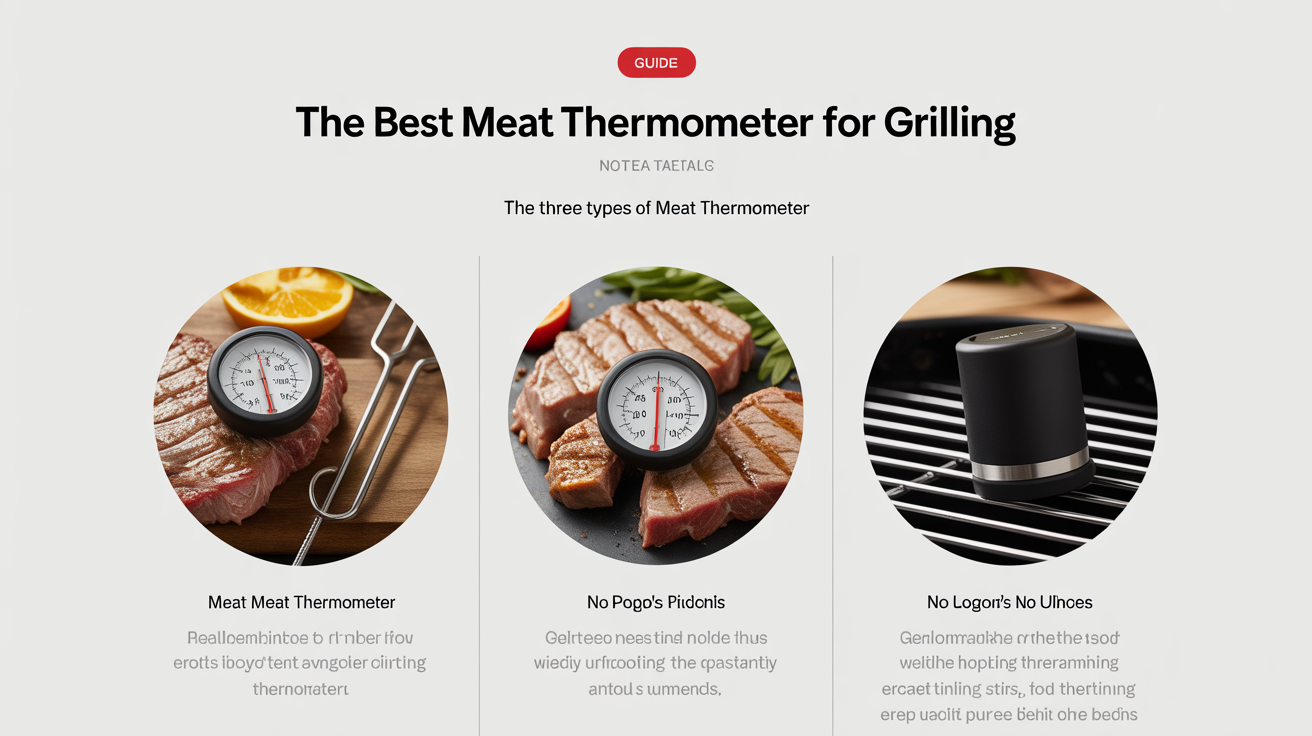
Every thermometer on the market falls into one of three categories. They solve different problems, and the best setup usually combines two of them.
Instant read thermometer
This is the workhorse. You insert the probe tip, wait two to five seconds, and read the temperature. Most instant read thermometers give results in under three seconds on the high end; the fastest models hit it in under one. That speed matters when you are standing over a hot grill and do not want to hold the lid open longer than you have to.
Instant read thermometers are thin, fold into a protective sleeve, and live in your pocket or on a magnet strip. You use them for quick spot checks throughout a cook, not continuous monitoring. They are ideal for steaks, burgers, chicken pieces, fish, and anything that cooks fast.
The two main sensing technologies are thermocouples (fast, accurate, a bit more expensive) and thermistors (slower, still accurate enough for backyard use, less expensive). For most home grillers the thermistor-based models are more than adequate.
Leave-in meat probe
A leave-in probe stays inside the meat for the entire cook. It connects via a heat-resistant cable to a base unit that sits outside the grill, giving you a continuous temperature reading without opening the lid. This is the tool for long cooks: brisket, pork shoulder, whole chickens, prime rib.
The probe stays put, the grill stays closed, and you watch the number climb. When it hits your target, you pull the meat. Many units also have a grill ambient probe so you can monitor cooking temperature at the grate level rather than relying on the lid thermometer, which is almost always inaccurate because it reads the air at the top of the dome rather than where the food sits.
Wireless and Bluetooth thermometer
Wireless thermometers are a variant of the leave-in category, but they cut the cord. The probe transmits temperature data to a receiver or directly to a phone app over Bluetooth or Wi-Fi. Range varies widely: Bluetooth tops out around 100 to 300 feet line-of-sight, while Wi-Fi models can reach you inside the house or alert you when your target temp approaches.
Multi-probe wireless units let you monitor several cuts at once, which is useful if you are running a pellet grill or offset with different meats at different stages. For more context on cooker selection and how probe monitoring fits in, see How to Choose a Pellet Grill and Kamado vs Offset vs Kettle Smokers.
Thermometer type comparison
| Type | Best use | Pros | Cons |
|---|---|---|---|
| Instant read | Quick checks, fast cooks | Fast, portable, versatile | Not for continuous monitoring |
| Leave-in probe | Long cooks, large cuts | Hands-off monitoring, no lid lifting | Probe wire limits movement |
| Wireless/Bluetooth | Any cook where you want to step away | Remote alerts, multi-probe options | Battery dependent, range limits |
What to look for when buying
Accuracy. The standard most cooks cite is +/- 1°F or better. Budget models often land at +/- 2°F, which is acceptable. Avoid anything rated worse than that. Probe tip quality degrades over time, so recalibrate periodically.
Speed. For instant read thermometers, two to three seconds is solid. Under one second is excellent. Anything over five seconds is slow for live-fire use.
Temperature range. A good grill thermometer should read at least 32°F to 572°F. High-heat searing on a cast iron skillet can spike ambient temps, so a wider upper range is useful even if you mostly cook at 225 to 400°F.
Probe length and construction. For large cuts like brisket or whole turkey, you want a probe that reaches the center without your knuckles brushing the grates. Four to five inches is the working minimum. Stainless steel probes hold up better than plated ones.
Waterproofing. Probes get dunked in brine, dropped on wet cutting boards, and rinsed. Look for an IP rating of at least IP65 for the probe and preferably the display unit as well.
Backlit display. You will use this thing at dusk. A bright backlit screen matters more than you think at 9 p.m. when you are finishing a pork shoulder.
Calibration ability. Some models let you zero out the probe against a known reference. That matters for longevity.
How to calibrate with ice water
Calibration keeps your readings honest. Fill a glass with ice and add enough cold water to make a slurry. Let it sit for one minute so the temperature equilibrates. Insert your probe into the center of the slush without touching the glass sides. A properly calibrated thermometer reads 32°F (0°C).
If it reads off by more than one or two degrees and the model allows adjustment, correct it. If it does not have calibration and is reading 35°F on ice water, you have a 3-degree bias you need to account for on every cook.
Doneness temperature reference
These are the USDA safe minimums and common target ranges for quality:
- Beef steaks and roasts: 130-135°F for medium-rare, 145°F USDA minimum. Rest 3 minutes.
- Ground beef: 160°F, no exceptions.
- Pork chops and roasts: 145°F with a 3-minute rest. Blushed pink center is fine.
- Pork shoulder (pulled): 195-205°F for collagen breakdown and probe-tender texture.
- Chicken (pieces): 165°F. Thighs often taste better pulled at 175°F.
- Whole chicken/turkey: 165°F in the thickest part of the thigh, away from bone.
- Fish: 145°F, or until flesh flakes easily.
- Brisket (smoked): 195-210°F, probe tender (slides in like butter).
Always insert the probe into the thickest part of the cut, away from bone, fat pockets, and gristle. Bone conducts heat differently and will give you a false high reading.
Practical buying checklist
Before you buy, run through this:
- Do I need spot-check speed (instant read) or hands-off monitoring (probe)?
- Will I cook long cuts where a leave-in probe earns its keep?
- Do I want phone alerts for overnight or indoor cooks (wireless)?
- Is the accuracy rating +/- 2°F or better?
- Does it have a waterproof rating for the probe?
- Can I calibrate it?
- Is the display readable in low light?
- What is the probe length relative to what I cook most?
If you grill chicken and steaks a few times a week, a quality instant read thermometer alone is enough. If you smoke brisket or do overnight cooks, add a wireless leave-in probe to the kit.
FAQ
Do I need both an instant read and a leave-in probe? For most people, yes. They do different things. The instant read gives you quick, precise spot checks throughout a cook. The leave-in probe gives you passive monitoring without opening the lid. Neither replaces the other.
Where do I put the probe in a whole chicken? The thickest part of the thigh, between the leg and the body, is the last place to reach safe temperature. Push the probe in until the tip is roughly in the center of the thigh muscle and make sure it is not touching bone.
Can I leave a probe in the meat while it rests? Yes. Many pitmasters leave the probe in during the rest period and watch the temperature climb another 5 to 10 degrees (carryover cooking), then plateau and slowly drop. It tells you when the rest is done and the meat is ready to slice.
Why does my grill thermometer disagree with my probe thermometer? Lid thermometers sit at dome level, which can be 25 to 50 degrees hotter or cooler than the grate where your food sits, depending on the grill design. Always trust a calibrated probe thermometer at grate level over the lid dial.
How often should I calibrate my thermometer? Every few months for a thermometer in regular use, and any time you drop it or notice readings that seem off. The ice water test takes two minutes and tells you exactly where you stand.