Gear & Grills
Kamado vs Offset vs Kettle Smokers
A practical breakdown of three major types of smokers: kamado grills, offset smokers, and kettle grills. Find out which one fits how you cook.
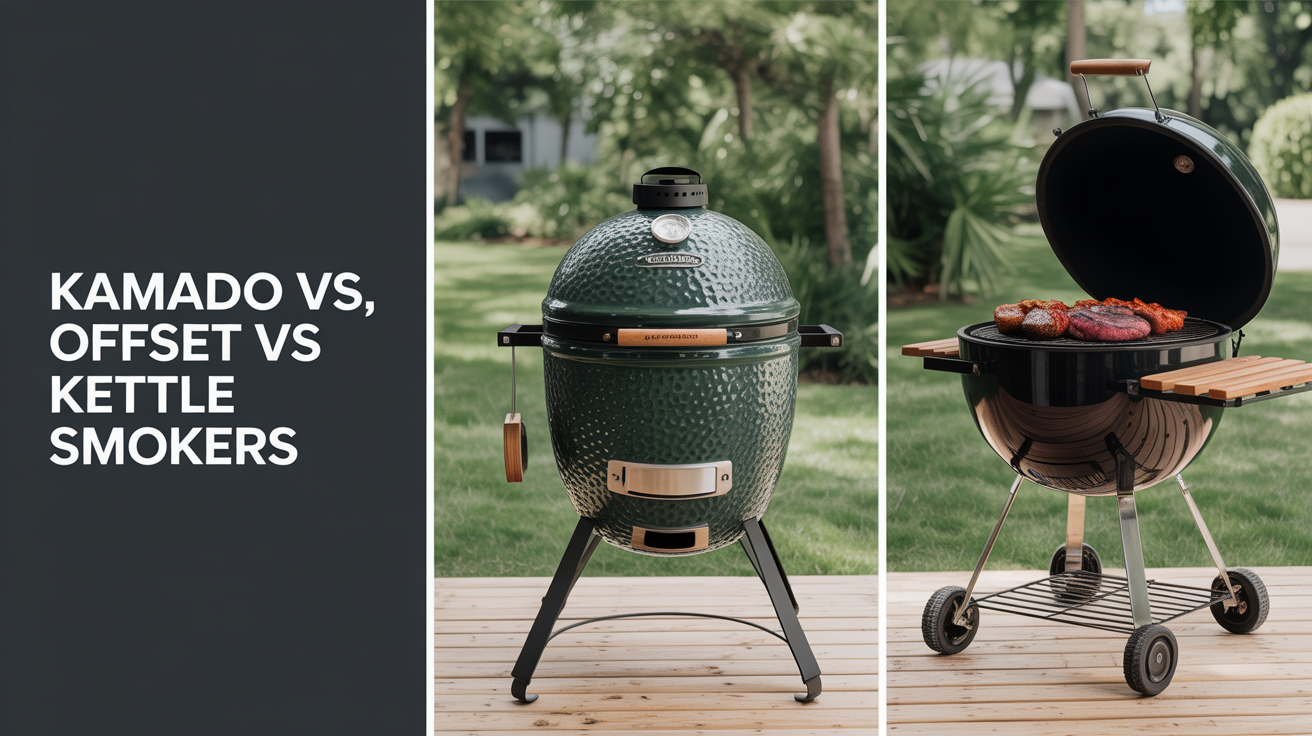
If you've spent any time researching backyard smoking setups, you've run into the same three names over and over: kamado, offset, kettle. Each has a devoted following. Each has real tradeoffs. And none of them is the "best" in any absolute sense because that depends entirely on what you're cooking, how often you cook it, and how much space and money you're willing to commit.
This article breaks down how each type actually works, where it excels, and where it frustrates. The goal is a clear picture, not a sales pitch.
How each type works
Understanding the mechanics tells you most of what you need to know before you ever light a fire.
Kamado grills are ceramic-shell cookers that trace their design back to Japanese clay cooking vessels. The thick ceramic walls absorb and radiate heat with unusual efficiency. A kamado uses lump charcoal as its primary fuel, and temperature is controlled through two vents: a bottom draft door and a top daisy wheel. Close them down and you can hold 225°F for twelve hours on a single load of charcoal. Open them up and you can sear a steak at 700°F. That range is genuinely rare in a single cooker.
The ceramic mass also makes a kamado grill forgiving. Once it settles at a temperature, minor wind or ambient changes don't knock it off course the way they would a thinner-walled grill. The tradeoff: ceramic is heavy. A large kamado can weigh 250 pounds or more, which means it rarely moves once it's placed.
Offset smokers work on a different principle entirely. The firebox sits beside the cooking chamber, not underneath it. You burn splits of hardwood (or charcoal plus wood chunks) in the firebox, and heat and smoke travel horizontally through the cooking chamber before exiting through a chimney on the far end. This is how Texas barbecue joints cook brisket. The smoke flavor is pronounced, the bark development is excellent, and the process demands real attention.
Temperature management on an offset smoker is a hands-on skill. You're adding wood every 45 to 60 minutes, adjusting dampers, and reading the fire constantly. There's no "set it and walk away." A cheap offset with thin steel walls (under 1/4 inch) will run hot on the firebox end and cold on the chimney end, making even cooking nearly impossible. This is where the market splits sharply: budget offsets under $500 are often frustrating, while well-built stick burners from makers like Yoder, Lang, or Horizon cost $1,500 and up and perform on a different level.
Kettle grills were not designed as smokers, but with the right technique they function well as one. The Weber Original Kettle is the canonical example. The snake method (arranging charcoal briquettes in a curved line around the perimeter of the charcoal grate, with wood chunks tucked in) allows a kettle to hold smoking temperatures for four to six hours without refueling. Heat and smoke circulate under the domed lid, and the two-vent system gives decent temperature control.
Kettle grill smoking has limits. Capacity is modest, and long smokes on large cuts require more babysitting than a kamado would. But the entry price is low, the learning curve is reasonable, and if you already own a kettle, you may not need to buy anything else to start smoking.
Comparison at a glance
| Type | Primary Fuel | Temp Stability | Cooking Capacity | Best For | Price Range |
|---|---|---|---|---|---|
| Kamado grill | Lump charcoal | Excellent | Medium (cooking grate only) | Low-and-slow + high-heat searing | $400-$2,000+ |
| Offset smoker | Hardwood splits or charcoal + wood | Variable (skill-dependent) | Large (multiple racks) | Traditional BBQ, big cooks | $300-$3,500+ |
| Kettle grill | Charcoal briquettes or lump | Good (limited duration) | Small to medium | Versatile backyard cooking, entry smoking | $100-$500 |
Fuel efficiency and running costs
A kamado's ceramic shell makes it one of the most fuel-efficient charcoal cookers available. A long smoke that might burn through ten pounds of charcoal in a standard grill will use five or six pounds in a kamado. That adds up over a season.
Offset smokers are the least efficient by design. A full firebox of splits burns down in under an hour, and you'll go through a meaningful pile of wood over a day-long brisket cook. If you have access to cheap hardwood, this is a non-issue. If you're buying splits by the bag at a hardware store, it's worth factoring in.
Kettle grills using the snake method are reasonably efficient for their size. A properly arranged snake of briquettes will run four to six hours without intervention, which covers most pork ribs and chicken cooks comfortably.
Temperature stability and range
For sustained low-temperature smoking, the kamado wins. It holds 225-250°F with minimal adjustment once it's dialed in. It also reaches searing temperatures that an offset or kettle can't match without modification.
Offset smokers, particularly budget models, can swing 50°F or more across the length of the cooking chamber. Experienced pitmasters rotate meat during the cook to account for this. A well-built heavy-gauge offset narrows that gap considerably.
Kettles are capable at smoking temps but have a narrower effective range at the high end. Pushing a kettle above 500°F is possible but not its strength.
Whichever cooker you're running, the internal temperature of the meat is still what determines doneness, not the dial on the lid. AmazingRibs' safe-temperature guide is a useful reference for the USDA minimums and where working pitmasters actually pull each cut, regardless of which of these three cookers got it there.
Capacity and cooking surface
Offset smokers win on capacity. A mid-size offset has room for two packer briskets, a rack of ribs, and a pork shoulder at the same time. This makes them the right choice for people who cook for crowds or want to run large batches.
Kamados have a single main cooking grate, though most accept multi-tier racks that add space. They're better suited to cooking for two to six people than for a neighborhood event.
Kettles offer the least surface area of the three. A 22-inch kettle gives you about 363 square inches, which is enough for a rack of ribs or a whole chicken, but things get tight quickly.
Learning curve
Kettle grill smoking is accessible. The snake method is well-documented, and small mistakes don't compound badly. A cook who's patient and has a reliable meat thermometer can produce good results within a few sessions.
Kamado grills have a moderate learning curve. The main adjustment is understanding that the ceramic heats slowly and overshooting your target temperature is hard to correct quickly. New kamado users often overshoot 250°F and spend an hour fighting to get the temp back down. The fix is simple once you know it: bring the temperature up in stages rather than opening the vents all the way at once.
Offset smoking is genuinely difficult to master. Fire management is a skill, reading the smoke color matters, and the relationship between vent position, wood species, and ambient conditions takes time to internalize. The payoff is exceptional, but expect a learning period of several cooks before things click. Michigan State University Extension's overview of smoking as a cooking method is a decent starting point if you're coming to any of these three cookers with no smoking background at all.
What each type does best
- Kamado grill: Everyday charcoal cooking, long low smokes, high-heat searing. The most versatile of the three if you're cooking solo or for a small family.
- Offset smoker: Traditional Texas-style BBQ, pork shoulders, brisket, whole hog. Right for people who want the full stick-burner experience and have the time and inclination to tend a fire.
- Kettle grill smoking: Budget entry into smoking, or an all-purpose backyard cooker that handles grilling, indirect cooking, and occasional smokes without requiring a dedicated smoker.
For more context on another direction entirely, see How to Choose a Pellet Grill if you want automated temperature control and wood pellet convenience. And whatever cooker you choose, a set of reliable tools will make the difference between a frustrating cook and a clean one.
Practical buying advice
Budget under $400: Start with a 22-inch kettle. You'll learn fire management and smoke, and if you later upgrade to a kamado or offset, those skills transfer directly.
Budget $400-$1,000: A mid-size kamado (Big Green Egg Medium, Kamado Joe Classic I, or similar) is a serious piece of equipment at this price. It will last decades with basic care.
Budget $1,000 and up for an offset: Don't buy a cheap one. A thin-walled offset at $350 will frustrate you. Save up for a well-built unit with at least 1/4-inch steel walls, or wait for a used quality offset locally.
FAQ
Can a kettle grill really smoke meat, or is it just a substitute? It's not a substitute so much as a different tool with different limits. A kettle can produce genuinely good smoked ribs, chicken, and even pork shoulder. It won't do a 14-hour brisket as cleanly, and capacity is limited. For most backyard cooks who want to smoke occasionally rather than obsessively, a kettle is completely adequate.
Is a kamado grill worth the price over a standard charcoal grill? For people who grill more than twice a week or who smoke regularly, yes. The fuel savings over time offset part of the cost, and the temperature stability changes how smoking feels. For someone who grills six times a summer, a kettle makes more financial sense.
Do I need to use wood splits in an offset smoker, or can I use charcoal? Both work. Many backyard cooks use a charcoal base fire and add wood chunks or splits for smoke flavor. This is easier to manage than an all-wood fire and produces very good results. Competition pitmasters and traditionalists tend to run all wood, but it's not required.
How long does it take to get a kamado to smoking temperature? Plan for 20 to 30 minutes of startup time. Because the ceramic absorbs heat before stabilizing, you'll light the charcoal and wait for the walls to come up to temperature before vents are fully set. Rushing this step is how you overshoot.
Which type of smoker produces the most smoke flavor? Offset smokers running hardwood logs produce the most pronounced smoke flavor, which is why they're associated with traditional barbecue. Kamados and kettles produce good smoke character but at a lower intensity, since the charcoal is the primary fuel and wood is added for flavor rather than being the entire fire.