Gear & Grills
Grilling Tools Worth Owning
A practical guide to essential grilling tools — what to buy, what to skip, and how each piece of gear actually earns its space beside the grill.
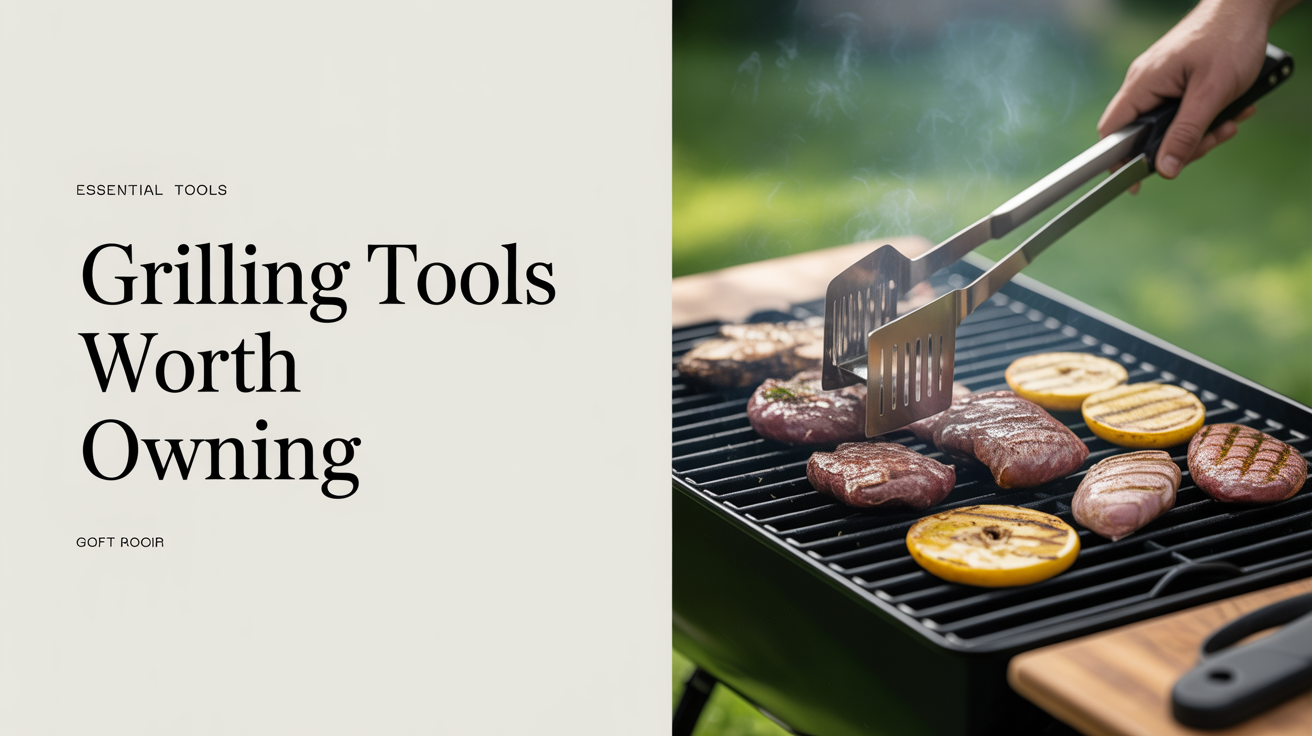
Most grill setups work fine with a handful of well-chosen tools. The problem is that the grilling accessories market is crowded with gadgets that look useful on packaging and collect grease in a drawer. This guide cuts through that. Below you'll find the tools that actually matter, the ones that are nice once you're already sorted on the basics, and a short list of things you can leave on the shelf.
If you're still deciding which grill to cook on, the tool question depends a bit on the setup. A charcoal kettle and a pellet grill have different needs, Kamado vs Offset vs Kettle Smokers walks through those distinctions, and How to Choose a Pellet Grill covers the pellet side specifically.
The essential grilling tools
These are the non-negotiables. If you're buying your first set of bbq tools, start here and stop until you've cooked with them enough to know what's missing.
Instant-read thermometer
Nothing else on this list does more to improve your food. An instant-read thermometer is the single most useful piece of grilling gear you can own, and it's the one tool that separates cooks who guess from cooks who know. A good thermometer reads in two to three seconds, holds calibration over time, and has a probe long enough to reach the center of a thick cut without putting your hand over the coals.
Don't buy a dial-style thermometer. The needle takes too long and the reading drifts. A quality digital model isn't expensive. The Best Meat Thermometer for Grilling has more detail on what specs to look for.
Long tongs
Get tongs that are 16 inches long with a scalloped grip at the tip. Shorter tongs put your hand too close to the heat; tongs with flat tips let food slip. The spring tension should feel firm but not stiff. You'll use these for everything: moving coals, repositioning food, pulling vegetables off the grate.
Buy one pair and use them hard. A second pair is fine if you cook for crowds, but you don't need three.
Sturdy spatula
A wide, thin-bladed spatula is the right tool for burgers, fish fillets, and anything else that tears if you try to lift it with tongs. Look for a blade that's at least three inches wide and offset enough that your knuckles clear the grate. Stainless steel holds up; cheap plastic warps on the first hot cook.
A too-short handle is the most common flaw in entry-level spatulas. Measure the handle before you buy, 14 inches is a reasonable minimum for a charcoal or gas setup where the grate sits close to the coals.
Chimney starter
If you use charcoal, a chimney starter is mandatory. It lights coals evenly in about 15 minutes with nothing but a couple of sheets of newspaper. Lighter fluid is slower, adds an off-flavor risk, and costs money every time you use it. A chimney starter costs roughly the same as a few bags of lighter fluid and lasts for years.
The standard 7.5-quart size handles enough coals for a full kettle. Smaller models exist for quick cooks.
Heat-resistant gloves
Oven mitts work. Silicone gloves work better because they're easier to clean and give you more grip when you need to adjust a grate or reposition a cast-iron skillet directly over coals. Look for gloves rated to at least 450°F. Anything higher is useful if you cook on a kamado at high heat.
Don't skip this in favor of doubled-up kitchen towels. A wet towel conducts heat and burns fast.
Grill brush alternative (or a good scraper)
The traditional wire brush has a real safety issue: bristles break off and stick to grates, then transfer to food. There are documented injuries. Skip the wire brush and use a coil-style scraper or a wooden grill scraper that conforms to the grate as it seasons. Both work well on a hot grate. A half-onion cut flat side down works too, dragged across the grates with tongs after the grill heats up, the moisture cleans and the natural oils condition at the same time.
Nice-to-have grilling accessories
Once you've cooked with the essentials for a season, these are worth adding.
Basting brush
A silicone basting brush handles sauces and marinades without absorbing them, and it's easy to wash. Get one with a handle at least 12 inches long so you're not holding your hand over a hot grate every time you apply a glaze. Natural-bristle brushes work fine but hold too much liquid and are harder to clean after a sticky barbecue sauce sets.
A basting brush matters most for ribs, chicken thighs, and anything you're finishing with a sweet sauce. On plain steaks or chops, you often don't need it.
Grill basket
A grill basket is the right tool for small or delicate food that would fall through the grate, shrimp, sliced peppers, cherry tomatoes, thin asparagus spears. A flat perforated basket is the most versatile shape. Wok-style baskets are fine for stir-fry-style cooks over high heat but aren't as useful for everything else.
You don't need a basket until you find yourself improvising with foil packets or skewers and getting frustrated. When that happens, the basket is worth it.
Rib rack
If you cook ribs regularly, a rib rack lets you stand slabs vertically so you can fit three or four on a grill that would otherwise hold two flat. On a kettle or pellet grill, that's a meaningful increase in capacity. For occasional rib cooks, it's easy to manage without one.
What to skip
Grill press. A heavy press compresses burgers and pushes out juices. The result is a denser, drier patty. Skip it.
Infrared thermometer. It reads surface temperature, not internal temperature. It's useful for knowing if a cast-iron pan is up to heat, but an instant-read thermometer already covers everything you actually need.
Dedicated corn holders. Corn on the cob can be held by the husk or with a regular kitchen fork. The small plastic corn cob holders are fine but genuinely unnecessary.
Marinade injectors. For most home grilling, surface application of seasoning and salt is enough. Injectors are useful for competition-style whole briskets or pork shoulders, which is a specific project, not a default need.
Tool summary
| Tool | Why it matters | Essential? |
|---|---|---|
| Instant-read thermometer | Only reliable way to hit target internal temps | Yes |
| Long tongs (16") | Moves food safely at distance from heat | Yes |
| Sturdy wide spatula | Lifts delicate food without tearing | Yes |
| Chimney starter | Lights charcoal evenly, no lighter fluid needed | Yes (charcoal) |
| Heat-resistant gloves | Protects hands, better grip than towels | Yes |
| Grill scraper or coil cleaner | Cleans grates safely, no loose bristles | Yes |
| Silicone basting brush | Applies glazes cleanly, easy to wash | Nice to have |
| Grill basket | Holds small food that falls through grates | Nice to have |
| Rib rack | Increases capacity for slab ribs | Nice to have |
| Wire brush | Loose bristle hazard | Skip |
| Grill press | Dries out burgers | Skip |
FAQ
How many tools do I actually need to start grilling?
Six covers almost everything: thermometer, tongs, spatula, chimney starter (if you're on charcoal), gloves, and a grill scraper. That's the full kit. Add a basting brush and grill basket after your first season if you find yourself wanting them.
What's the biggest mistake people make when buying grilling accessories?
Buying too many single-use gadgets. A dedicated corn cob holder, a burger press, a fish spatula and a regular spatula and a wide spatula, these accumulate fast. Start with one pair of tongs, one spatula, and a thermometer. You'll learn what you actually miss before spending more.
Do I need different tools for gas vs. charcoal?
The chimney starter is charcoal-specific. Everything else on the essential list works for both. If you're on gas, you might not need gloves rated as high since the grates usually sit a bit higher above the burners, but heat-resistant gloves are still useful for moving grates or adjusting cast-iron cookware.
How do I clean grill grates without a wire brush?
Heat the grill to high for 10 to 15 minutes, then use a coil-style stainless scraper, a wooden scraper, or the cut side of a halved onion held with tongs. For stubborn buildup, a ball of crumpled aluminum foil gripped with tongs scrubs grates well. Avoid soap on cast-iron grates; rinse with hot water and dry immediately.
Is it worth spending more on a quality thermometer?
Yes, to a point. A mid-range instant-read thermometer reads in two to three seconds, stays accurate, and lasts for years. A cheap dial thermometer is often wrong and always slow. You don't need to spend top dollar, but skimping on the thermometer is the most common tool regret among people who cook on a grill regularly.