Fire & Fuel
How to Use a Charcoal Chimney Starter
Learn how to use a chimney starter to light charcoal fast, without lighter fluid. Includes fill levels, timing, safety tips, and common mistakes.
If you have ever tasted that faint chemical edge in grilled food and wondered where it came from, the answer is usually lighter fluid. A charcoal chimney starter eliminates the problem entirely. It is a simple steel cylinder that uses nothing but newspaper and airflow to get coals burning hot in about 15 minutes. No additives, no off-flavors, and no waiting for fluid to burn off before you can cook.
This guide covers everything you need: how a chimney works, how to use one step by step, how much charcoal to load for different jobs, and a few safety habits worth building early.
At a Glance
- A chimney starter lights charcoal with just paper and airflow, no lighter fluid required.
- Standard cooks are ready in 10 to 15 minutes; searing heat takes closer to 18 to 20 minutes.
- Match the fill level to the job: a quarter chimney for warming, a full chimney for high-heat searing.
- Wait for at least 50% gray ash before pouring; wait for 80 to 100% if you want maximum heat.
- Always set the chimney on a non-combustible surface, away from siding, railings, and anything overhead.
- Dump spent ash into a metal container with a lid, never plastic or cardboard, even hours after the cook.
What a chimney starter actually is
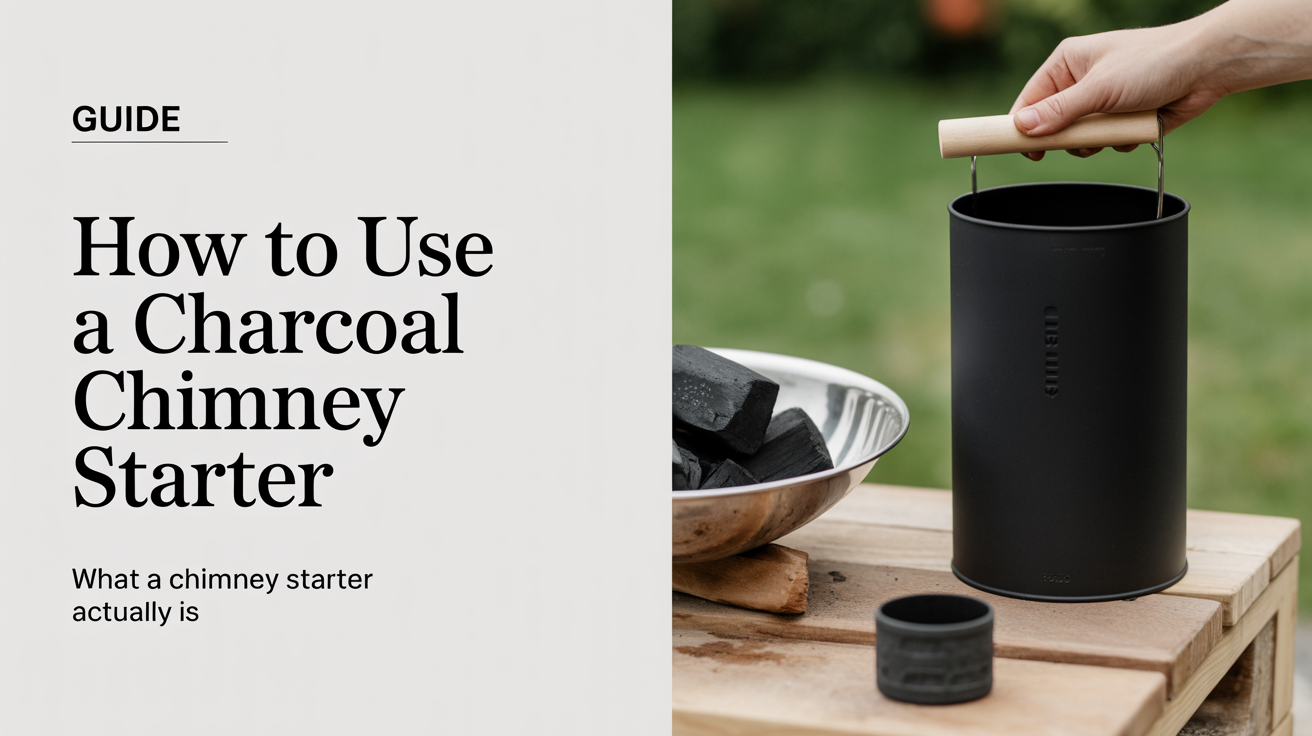
A charcoal chimney is a cylindrical metal tube, typically 6 to 8 inches wide and 10 to 12 inches tall, with a grate inside that divides it into two chambers. The upper chamber holds charcoal. The lower chamber holds your fire starter. Slots or holes around the bottom let air in; heat and combustion gases rise through the charcoal above, lighting it from below and creating a self-sustaining draft, the same principle as a wood stove.
Most chimneys hold between 80 and 100 briquettes, or roughly the equivalent in lump charcoal. The handle stays cool enough to grip, which matters when you have a cylinder full of 800°F coals ready to pour.
You do not need an expensive model. A sturdy steel chimney from any hardware store works fine. The one feature worth paying for is a solid handle with a thumb shield that keeps your knuckles away from radiant heat when you tip the coals out. Cheaper chimneys sometimes use thin gauge steel that warps after a season or two of heat cycling; a chimney with a rolled top rim and welded (not riveted) handle joints tends to last years longer.
Why it beats lighter fluid
Lighter fluid soaks into the charcoal and takes time to burn off completely. Most of it does burn before you cook, but a residual petro-chemical smell lingers on the grate and in the ash, and it can carry into whatever you are cooking if you add food too early.
This isn't just a matter of taste. The EPA has studied lighter fluid emissions directly, and its report on charcoal lighter fluid alternatives estimates that Americans burn through roughly 46,000 tons of charcoal starter fluid a year, releasing an estimated 14,500 tons of volatile organic compounds in the process, split between evaporation before ignition and combustion afterward. None of that is present with a chimney. It uses only paper and heat.
A chimney starter uses only paper and heat. When the coals are ready, they are ready. There is no off-gassing to wait out. The flavor you taste comes from the charcoal, the wood, and the meat, not from petroleum.
For a deeper comparison of which charcoal to buy in the first place, see Lump Charcoal vs Briquettes.
How to use a chimney starter, step by step
-
Set the chimney on the charcoal grate inside your grill, or on a heatproof surface outside the grill if you prefer to load coals into a cold grill after they are ready. Either works.
-
Add newspaper or a fire starter cube to the bottom chamber. Two to three sheets of newspaper, loosely crumpled, is the classic method. Wax-based fire starter cubes or compressed cardboard discs also work and are less affected by wind.
-
Fill the top chamber with charcoal to the level appropriate for your cook (see the table below).
-
Light the newspaper through the holes at the base. A long match or a butane lighter is safer than a short match. Light in two or three spots around the perimeter so the paper catches evenly.
-
Leave it alone for 10 to 15 minutes. You will see smoke at first, then small orange flames licking up through the charcoal. After about 10 minutes, the coals at the top will start showing a gray-white ash coating on their edges.
-
Wait until the top layer is at least 50% ashed over. This is the minimum for cooking. For higher-heat searing, wait until the top coals are 80 to 100% gray-white and you can see an orange glow from within the pile.
-
Put on heat-resistant gloves, grip the handle, and pour the coals where you need them in the firebox. Tip steadily and direct the flow; do not dump from too high or coals will bounce.
-
Arrange your coal bed for direct heat (spread evenly), two-zone cooking (bank to one side), or snake/minion method for low and slow. Then put the cooking grate on and let it preheat for a few minutes before you cook.
That is the whole process. Once you have done it twice it becomes automatic.
How much charcoal to use
Fill level is one of those chimney starter tips that new grillers often overlook. A full chimney for a quick burger cook is overkill and will make the grill too hot to control. A half-fill for a long brisket cook will leave you cold before the stall.
| Fill Level | Approximate Briquettes | Best For |
|---|---|---|
| 1/4 chimney | 20-25 | Indirect finishing, warming, small kettle low-and-slow |
| 1/2 chimney | 40-50 | Two-zone cooking, sausages, chicken thighs, longer cooks |
| 3/4 chimney | 60-75 | Most weeknight grilling, burgers, vegetables, fish |
| Full chimney | 80-100 | High-heat searing, full-grill direct heat, pizza-style cooks |
Lump charcoal burns hotter and faster than briquettes, so you often need slightly less of it by volume to hit the same temperature. A three-quarter-full chimney of lump can match a full chimney of standard briquettes for heat output.
For the full picture on managing temperature once the coals are down, see How to Control Grill Temperature.
Reading the ash: when coals are actually ready
New grillers often pour too early because "some gray" looks close enough. It isn't. The percentage of ash coverage tells you how much heat you're actually about to get, and it's worth learning to read at a glance.
| Ash Coverage | What You'll See | Ready For |
|---|---|---|
| 25-40% | Gray flecks at the very top, mostly black coal below, orange glow visible through gaps | Not ready. Wait 3-5 more minutes. |
| 50-60% | Top layer mostly gray-white with orange still showing through | Standard grilling, two-zone setups, most weeknight cooks |
| 80-100% | Entire pile gray-white, uniform orange glow visible from inside when you look down the chimney | High-heat searing, pizza-style cooks, thick steaks |
If you pour at 25 to 40%, you'll get a slow, smoky start with a lot of white smoke and inconsistent heat across the grate as the coals continue to catch after they're already spread out. Waiting the extra few minutes for even ash coverage gives you a fire that's ready to cook the moment it hits the grate, instead of one that's still catching up.
Chimney starter safety
A chimney full of lit coals is genuinely hot. A few habits prevent most accidents.
- Always set the chimney on a non-combustible surface. Concrete, the charcoal grate inside the grill, a cinderblock, anything that will not scorch or melt. Wooden decks are a common mistake.
- Keep the chimney away from combustibles while it burns. The outside of the cylinder gets hot, and embers can fall from the bottom slots. The U.S. Fire Administration's outdoor grilling guidance puts this plainly: keep any lit fire source well away from siding, deck railings, and anything overhead like eaves or branches.
- Use long gloves or welding gloves when pouring. Radiant heat comes off the top of a full chimney. Thin oven mitts are not sufficient.
- Tip the chimney in a single smooth motion. Hesitating mid-pour can direct hot coals toward you.
- Never leave a lit chimney unattended with children or pets nearby. It looks less alarming than open flames, but the heat output is significant. The same federal guidance is direct about this: don't walk away from a lit grill or fire source, even briefly.
- Set the empty chimney somewhere safe after pouring. The steel stays hot for 20 minutes or more after the coals are out.
Lighting charcoal chimney in wind or cold weather
Wind is actually helpful, it accelerates the draft and speeds up lighting. The problem is that wind can also blow newspaper out of the bottom before you get it lit. In breezy conditions, use a fire starter cube instead of newspaper. They are windproof and do not require lighting from multiple angles.
Cold weather slows the process but does not stop it. In temperatures below 40°F, add 5 to 8 minutes to your wait time. The draft still works; the ambient temperature just steals heat faster. If you're cooking in genuinely cold weather, load the chimney a few extra minutes ahead of when you think you'll need it rather than rushing the pour once the first coals ash over.
Rain is the real enemy. Wet newspaper does not light well and wet charcoal is almost impossible to start. Keep your charcoal stored in a sealed container or bag, and use a fire starter cube if humidity has gotten to your newspaper. A charcoal bag left open in a garage over a humid summer absorbs more moisture than most people expect; if a briquette feels soft or crumbles at the edge instead of snapping cleanly, it has already taken on water and will smolder rather than light cleanly.
What to do with the ash afterward
After your cook, close all vents to snuff the remaining coals. Once the grill is fully cold, dump the ash into a metal can, not a plastic bag, not a cardboard box, even hours after the cook. Coals can hold heat for a long time. Metal garbage cans with lids are the standard tool for ash disposal, and it's the same practice fire safety officials recommend for grill ash generally: cooled coals go into a metal container with a lid, never directly into household trash.
If you plan to add smoking wood chunks to a cook, start with the charcoal chimney, pour the coals, and lay the wood chunks on top. They will begin smoldering within a few minutes. For guidance on which woods pair with which proteins, see Best Wood for Smoking Different Meats.
FAQ
How long does a chimney starter take to light charcoal? In normal conditions, 10 to 15 minutes gets briquettes to a usable cooking temperature. Lump charcoal can be ready in 8 to 12 minutes because the pieces are less dense and ignite faster. Full-gray ash-over, if you want maximum heat for searing, takes closer to 18 to 20 minutes.
Can I reuse partially burned charcoal from a previous cook? Yes. Load leftover coals into the top of the chimney and light fresh newspaper below. They relight quickly because they are already partially combusted. Just make sure they are genuinely cold before you handle them, at least 24 hours after the previous cook, with all vents closed.
Do I need lighter fluid at all if I have a chimney? No. A chimney starter makes lighter fluid completely unnecessary. Newspaper or fire starter cubes are all you need. Many grillers who switch to a chimney never go back, partly for flavor reasons and partly because it is one less thing to buy and store.
My newspaper burns out before the charcoal catches. What am I doing wrong? Usually the newspaper is packed too tightly, which chokes airflow and smothers the flame. Crumple loosely so there is air space between the sheets. If the problem persists, switch to a wax fire starter cube, they burn longer and are not affected by drafts or tight packing.
Can I use a chimney starter with a gas grill? Technically yes, but it rarely makes sense. If you want charcoal flavor from a gas grill, there are charcoal inserts designed for that purpose. The chimney itself is not the issue; it is a universal lighting tool. But the workflow of managing a charcoal bed inside a gas grill adds complexity that usually is not worth it unless the grill is specifically designed for it.
Why does my chimney rust after a few months? Standard steel chimneys rust if they're stored outside uncovered or put away while still slightly damp from a rained-on cook. A light surface rust doesn't affect performance and can be brushed off. To slow it down, store the chimney under cover, dump ash out promptly rather than leaving it to sit, and let the metal cool and dry fully before you stack it away.
Is it safe to use a chimney starter on a wooden deck if I set it on a grill grate first? No. The grate alone doesn't insulate the deck from radiant heat, and a tipped or knocked-over chimney puts lit coals directly on wood. Use a dedicated non-combustible surface, concrete, pavers, or the charcoal grate inside a grill that's already sitting on a safe surface, not a grate resting loose on decking.